
Watch where the decisions go in a founder-led company.
Pricing exception? It waits for the founder.
New hire? Founder.
Unhappy customer? Founder.
A manager who wants to try something new? Founder.
The org chart shows a leadership team. The decisions still route through one office.
That’s founder dependency, and generic executive coaching rarely touches it. Most coaching aims at the leader and leaves the structure alone. The alternative is a coach who changes how decisions and authority move through the company, and writes it down.
I’ve sat in that chair. I took over our family business, Sullivan & Cogliano, the staffing company my father founded in 1966, and in 1993 I founded its education business. We made the Inc. 5000 three times, and for years I was still the person most decisions waited on. By the time we exited in 2018, I’d built a leadership team that could run the company without me in the middle of it.
Generic executive coaching builds a better bottleneck
Picture an airline that routes every flight through one hub. The hub can be the best-run airport in the country. One storm there and every flight in the system runs late.
Generic coaching improves the hub with better delegation habits and more self-awareness. All useful. The flights still route through you.
Delegation theater
Most founders I meet believe they’ve already delegated.
Their leaders own the projects. The founder still approves the decisions inside them. The meeting ends, and the real call gets made afterward in the founder’s office. The team has learned to bring options instead of answers.
From the outside it looks like delegation. Your team knows the difference.
Four things a founder-dependency coach changes
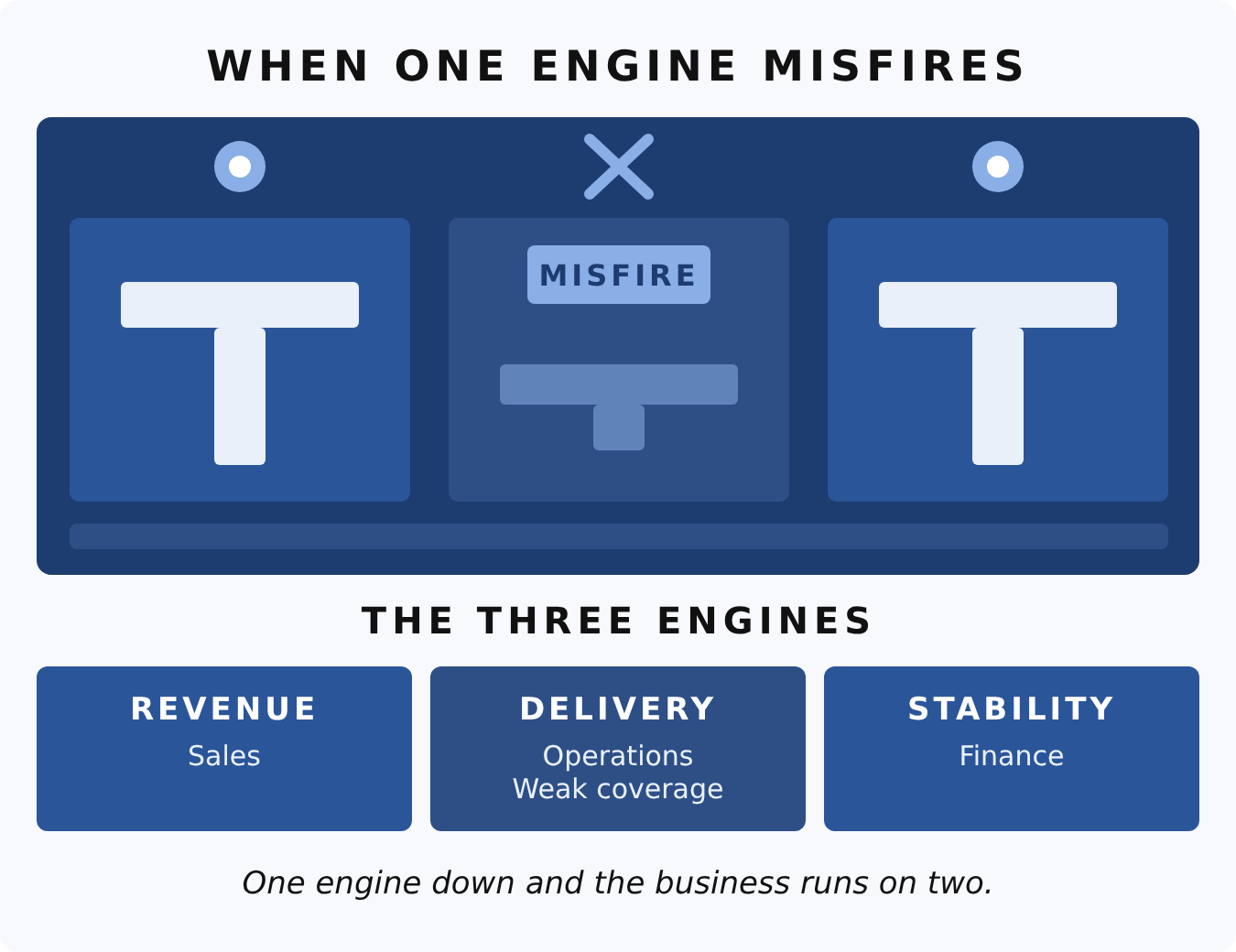
Seats. Your three engines each need an A-player in charge: the Revenue Engine (sales), the Delivery Engine (operations) and the Stability Engine (finance). Progress stalls when a founder won’t grade a B-player in one of those seats honestly.
Decision rights. On paper: which decisions are yours, which belong to your leaders, and which need a conversation first.
Graduated authority. Each function moves through three phases. The leader recommends, then decides, then runs it. Nobody hands an apprentice a master’s license on day one.
Rhythm. Quarterly priorities and meetings that surface problems before they reach your desk.
Step three is the one founders skip.
How graduated authority works
In the trades, a first-year apprentice doesn’t get a permit and a truck. The apprentice works under supervision. Over time they earn the right to work alone, and eventually the master’s ticket. Graduated authority moves a leader up the same ladder, one function at a time.
- Recommend. The leader recommends, and you approve. You review before anything happens, and when you override, you explain why. You advance when overrides are thinning out and recommendations arrive with real reasoning.
- Decide. The leader decides, and you review after. Your reviews shift from checking quality to coaching judgment. You advance when your reviews have stopped catching errors.
- Run. The leader runs the function within the guardrails, and you’re informed. You step in only when a threshold fires.
Each phase usually takes about a month. Advance on evidence, not the calendar. Only after a function runs a full quarter without you do you move on to the next one.
Scaling Up runs the system. Founder Independence moves the authority.
I’m a Certified Scaling Up Coach, and I’ve run my own companies on Verne Harnish’s system since early 2003, back when it was called the Rockefeller Habits. It gives a company its operating system: priorities, metrics and a meeting rhythm. Founder Independence uses that system to move authority off the founder and onto a team that can carry it. One plus one equals three.
One client: from bottleneck to working on the business
A professional services firm had one person carrying business development, account management and project management at once. Whatever that person couldn’t reach landed on the founder’s desk. We rewrote the job scorecard so the role had a clear mission and outcomes tied to the company’s strategy. Then a fractional CRO built a real sales system around it.
The founder was then able to work on the business more: opening more locations, developing leaders, and securing the funding needed to support growth.
Questions to ask before you hire a coach
Ask any coach you’re considering these five. The answers tell you whether they’ll work on the hub or reroute the flights.
- Have you run a company yourself, and did it run without you by the end?
- How will you find out which decisions are still waiting on me?
- Will we write down decision rights, function by function, or just talk about delegating?
- How do you decide when a leader is ready for more authority?
- What will my week look like in a year if this works?
A good coach answers the second question with something specific. If the answer is “we’ll work on your mindset,” you’re hiring a better hub.
Who this is for
Founder-led companies doing $3 million to $50 million in revenue, with at least the start of a leadership team. The founder wants to work on the business instead of in it, or wants time back for family, health and the rest of life. Either one counts.
If there’s no leadership team yet, start there. You can’t hand authority to an empty chair.
The next move
Run this test this week. Write down the last 10 decisions that waited on you.
Count how many your leadership team could have made without you.
That number is your starting point. For a fuller picture, take the 5-minute Founder Independence Diagnostic.
Hiring an executive coach? Pick one who changes where the decisions go.
The ideas in this guide are in my book, Founder Independence, with a foreword by Verne Harnish, coming in early 2027.
Frequently asked questions
What should a founder look for in an executive coach?
Someone who changes where decisions go, as well as how you lead. Look for a coach who has run a company, who will write down decision rights with your leadership team, and who moves authority to your leaders in stages.
How is founder-dependency coaching different from executive coaching?
Executive coaching usually works on the leader: habits, self-awareness, communication. Founder-dependency coaching works on the structure around the founder: who sits in each key seat, which decisions each leader owns, and how authority transfers. Both help. Only the second gets decisions off your desk.
How long does it take to make a company less dependent on its founder?
Each function takes about a quarter to move from the founder to a leader, and you move one function at a time. In the book I describe Founder Independence as a 36-month commitment.
Does this work alongside Scaling Up?
Yes. Scaling Up gives the company its operating system: priorities, metrics and a meeting rhythm. Founder Independence uses that system to move authority from the founder to the leadership team.
Who is this not for?
Companies without the start of a leadership team. You can’t hand authority to an empty chair, so the first job there is building the team.