
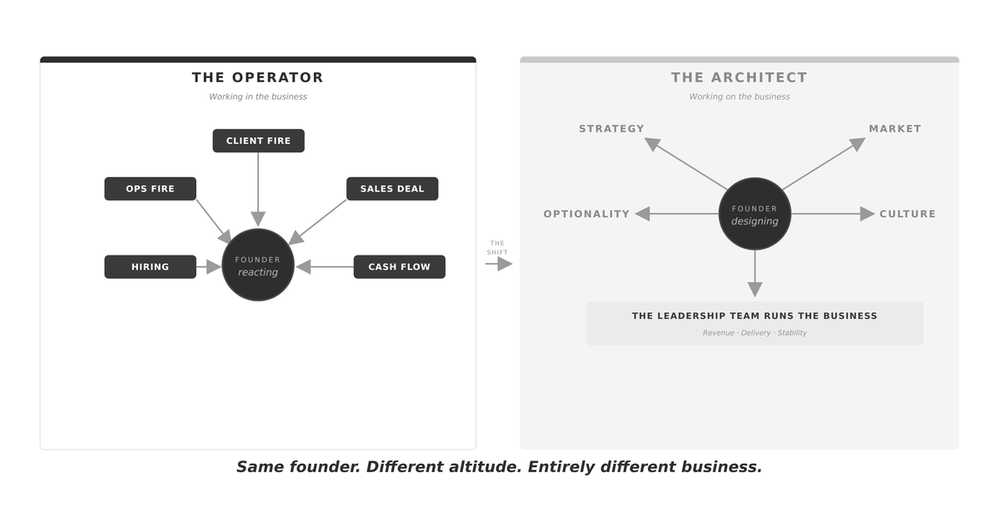
Your company is doing well and your family sees less of you. Here's the kind of help that gives founders their time back, and how to choose it.
By Herb Cogliano, executive coach, Certified Scaling Up Coach and CEPA
If your company is doing well and your family sees less of you every year, the help that lasts comes from an executive coach who works with you and your leadership team together, so the team can run the business without you. Peer groups and productivity systems each have a place too. Your time comes back when decisions stop landing on your desk, and that takes a team with the authority to make them. This guide shows you how to see where your time goes, what each kind of help does well, and how to hand the business off safely.
Why the time disappears
Picture a building where you hold the only set of keys. Everyone shows up early and works hard, and every door still waits for you. That is most founder-led companies between $3 million and $50 million. The business outgrew the founder’s calendar years ago, but the authority never moved.
I know this one from the inside. For years I ran drive-by meetings in the hallway. People caught me between rooms, I made the call, and I felt useful. What I had actually built was a company that waited for me. The fix was plain: daily and weekly huddles where the team brought the issues and settled them together. My evenings started coming back after that.
Step 1: Write your three lists
Take a sheet of paper and make three columns. In the first, list the work you do in the business: running meetings, approving, fixing. In the second, list the work only you should do on the business: strategy, acquisitions, capital, key senior hires. In the third, list your personal life: the people and plans you keep saying you’ll get to.
When I wrote mine, the third column was the one I’d put off the longest. At the top was triathlon training with my son, miles that carried us both across Ironman finish lines. Getting to the race took a 17-hour drive, and that drive turned out to be the part I treasure most. A nine-hole golf league, a family vacation and a trip to Italy were on that list too. If your first column is the longest and your third is the shortest, this guide is for you. The goal of everything that follows is to move hours from the first column into the other two.
Step 2: Count the decisions for one week
Now find out why the first column is so long. For five working days, write down every decision that reached you, who brought it, and whether someone else could have made it. You’ll likely be surprised twice: by how many decisions there are, and by how few truly needed you.
If most of the entries could have been made by someone else, your problem is structural. More discipline on your part won’t fix it.
Step 3: Match the help to the problem
Each kind of help does something real. The question is whether it moves decisions off your desk.
| Kind of help | What it does well | Where decisions sit afterward | Best fit |
|---|---|---|---|
| Productivity systems | Speeds up the work you already do | With you | Founders whose team already decides without them |
| Peer groups such as Vistage, YPO and EO | Perspective, accountability and CEOs who have been where you are | With you, until your team changes | A strong complement to the structural work |
| Executive coaching for the founder alone | Sharpens your own leadership | Depends on what gets built around you | Founders whose team is already in place |
| Executive coaching for the founder and the leadership team together | Builds the founder’s independence while empowering the team and holding it accountable for results | With a leadership team that owns its decisions | Founders who want their time back and a team that runs the business |
Many founders use more than one. A peer group alongside the structural work is a good combination.
Step 4: Hand off one function at a time: Recommend, Decide, Run
A common mistake founders make when they finally decide to step back is handing over authority and stepping back in one move. That’s abdication. It looks like trust while it’s happening, and the decisions usually come right back to your desk, along with a mess to clean up.
The alternative works like a trades apprenticeship. Nobody hands a first-year apprentice a permit and a truck. The apprentice, the journeyman and the master all build to the same code; what changes is how much each is allowed to do without someone standing behind them. In Founder Independence, your written authority is the code, and graduated authority is how an apprentice leader becomes a master. Pick one function, usually the one that interrupts your evenings most, and move it up the ladder in three phases:
- Recommend. Your leader owns the thinking and brings you a recommendation, and you approve before anything happens. Expect to override some calls here, and explain why when you do.
- Decide. Your leader decides, and you review afterward. Your job shifts from checking their work to coaching their judgment.
- Run. Your leader runs the function within the guardrails you’ve set, and keeps you informed. You step in only when a threshold is crossed.
Nobody makes journeyman just because a year went by, so advance a phase only when the evidence says so. In the book I put it as an equation: Authority + Guardrails = Safe Autonomy. When a decision that belongs to someone else lands on your desk, send it back. Every time you absorb one, your team learns the old way still works.
Step 5: Keep every door open
Time back is where it starts. A business that runs without you also opens choices that dependency keeps closed. In the book I call them the four doors. You can sell to an outside buyer at full value. You can hand off to the people already inside, such as family, your leadership team or your employees. You can recapitalize, taking money off the table with a partner while you keep running the company. Or you can architect and scale: you lead, your leadership team runs it, and you finally have room to build what you couldn’t reach while you were holding everything up. Every one of those doors leads to more time, and whichever you choose, you choose it with your evenings back.
Who helps founders get their life back?
Look for a coach who has run a company, not only advised one, and who works with your leadership team as well as with you. I’m Herb Cogliano, an executive coach and the founder of Aspire Growth Advisors. I work with the founder and the leadership team together: building the founder’s independence while I empower the team and hold it accountable for results. I’m a two-time founder with nearly four decades inside founder-led companies, a Certified Scaling Up Coach and a Certified Exit Planning Advisor (CEPA), with an MBA.
I’ve coached more than 30 founder-led companies and their leadership teams. Every engagement starts with a diagnostic: we find the one or two constraints that keep the business dependent on you, then work a 90-day focus inside a 12-month engagement. The full method, including the three lists and the Recommend, Decide, Run ladder, is in my book, Founder Independence, with a foreword by Verne Harnish, coming in early 2027.
Independence is earned, not declared. If your company still runs through you, book a conversation with me.
Frequently asked questions
What is founder independence?
Founder independence means your company runs, grows and makes good decisions without depending on you for every one of them. The founder moves from operator to architect: the leadership team runs the business, and the founder works on it, or steps back, by choice.
What’s the first step to getting my time back as a founder?
Write three lists: the work you do in the business, the work only you should do on the business, and your personal life. Then log every decision that reaches you for one week. Together they show where your time goes and which decisions your team could own.
Is a peer group enough to get my time back?
A peer group gives you perspective and accountability from founders who have been there, and it pairs well with this work. On its own it won’t change who makes the decisions in your company. If the decisions still reach you after a year, add the structural work.
How long until I see more time at home?
The first 90 days focus on one function, so the first hours come back as that function moves up the ladder from Recommend to Run. Moving decision rights across the whole leadership team is the work of the full 12-month engagement.
Can I cut back to part-time without selling my company?
Yes, if a leadership team holds the authority to run it. In the book I set a benchmark for this, the 1/5 Founder Standard: one day a week working in the business and four days working on it. Once your leaders run their functions, how you spend those four days, including how much of that time you spend away from the business, becomes your choice.
Does this only make sense if I plan to sell?
No. Founder independence makes an exit possible, but it doesn’t require one. Selling is one of four doors, alongside handing off to insiders, recapitalizing, and staying to architect and scale. The point is that the choice stays yours.