
The short answer
To take a mid-market company past $10 million to the next level, hire a certified Scaling Up coach who has run a company your size and who works with your whole leadership team, not only the CEO. The Rockefeller Habits, now taught as Scaling Up, give the team a shared system for strategy and execution. The coach’s harder job is moving decisions out of the founder’s office so the system runs without them.
This guide is for founder-led companies between roughly $10 million and $50 million in revenue. They have a leadership team on paper. Growth has slowed anyway.
Why mid-market companies stall
Think of a highway that has been widened from two lanes to six, with one toll booth still standing at the end. The company hired a VP of Sales, a controller and an operations lead. Traffic still backs up at the founder, because the big calls on pricing, key hires, large customers and capital spending wait for one signature.
At $3 million the founder does the work. At $15 million the founder approves the work, which feels like progress and often isn’t. The leadership team learns to bring decisions upward instead of making them. Meetings multiply. Good people leave because they were hired to lead and ended up asking permission.
Common signs at this size:
- The leadership team meets, but the real decisions happen later in the founder’s office.
- Quarterly priorities slip because each one needs the founder’s time.
- One or two key seats hold someone the company has outgrown, and everyone knows it.
- Revenue keeps rising while profit and cash stay flat.
- The founder is thinking about an exit and suspects the business is worth less with them gone.
What Scaling Up coaching does at this size
Verne Harnish introduced the Rockefeller Habits in Mastering the Rockefeller Habits and expanded them into the Scaling Up method. The method organizes a growing company around four decisions: People, Strategy, Execution and Cash. Its main tools are a One-Page Strategic Plan, quarterly priorities with one owner each, a daily and weekly meeting rhythm, and a short list of numbers the whole company tracks.
In a $10 million to $50 million company, the coach works with the leadership team as a group. A typical year includes an annual planning session, quarterly planning sessions, and regular work with the CEO between them. Three things get most of the attention at this size.
Grading the seats. Each key role gets a scorecard with measurable outcomes, and each person in it gets an honest grade. A B-player in a critical seat at $20 million costs far more than the same gap at $3 million. Founders who won’t make that call are the most common reason engagements stall.
Moving decision rights. Every recurring decision gets an owner, a limit and a check-in point. Leaders move through stages: they recommend, then they decide and report, then they run the function. The founder stops approving and starts reviewing.
Cash. Revenue growth at this size can drain cash faster than it creates it. Scaling Up’s cash tools look at how quickly the company turns sales into cash and which levers shorten that cycle.
Scaling Up coach, peer group, large firm or consultant
Mid-market CEOs usually weigh four kinds of help. They solve different problems, and many companies use more than one.
| Option | What you get | Best fit | Watch for |
|---|---|---|---|
| Independent Scaling Up coach | One certified coach working inside your business with the founder and leadership team | Founder-led companies, $10M to $50M, where execution and decision flow are the constraint | Check that the coach has run a company, not only a coaching practice |
| CEO peer group (Vistage, YPO, EO) | A monthly room of CEOs from other companies, led by a chair | CEOs who want outside perspective and peer accountability | The group advises the CEO; nobody works with your leadership team |
| Large coaching firm | A branded system delivered by a matched coach from a big bench | Companies that want a standard program and coach continuity | Quality depends on which coach you’re assigned; interview that person |
| Management consultant | A project with a defined deliverable, such as a pricing study or reorganization | A specific problem with a clear end point | The team may not own the result after the consultants leave |
A peer group and a coach pair well. The group shows you what other CEOs see. The coach helps your team act on it every week.
How to choose a Scaling Up coach
There are a few hundred certified Scaling Up coaches worldwide, and the certification tells you they know the tools. These questions tell you whether they can use them in a company your size.
- Have you led a company of this size? Ask what it was, how big it got, and how it ended.
- Which current clients are between $10 million and $50 million, and can I call one? The tools are the same at $5 million and $40 million. The politics of a leadership team are not.
- How do you move decisions away from the founder? Ask for the stages and roughly how long each takes.
- How do you handle a leader who isn’t working out? You want a coach who will name it, and who leaves the decision with you.
- Who facilitates planning, and who coaches between sessions? At some firms those are different people.
- How do you connect scaling to exit readiness? Even if a sale is years away, the same work raises what the company is worth.
Scaling and exit readiness are the same work
Most mid-market founders I meet are thinking about what comes next, even when the exit is five or ten years out. A buyer asks the same question a good coach asks: does this company run without the founder? If the answer is no, the price drops. If the buyer is your own leadership team, the problem is sharper. Insiders usually pay over time out of company profits, so a business that depends on you puts your payments at risk.
As a Certified Exit Planning Advisor, I measure readiness through three gates:
- Business Readiness. Can the company perform without the founder in the daily decisions? This gate is scored on the value drivers buyers look at, from management depth to recurring revenue.
- Owner Readiness. Is the founder ready, financially and personally, for whatever comes next?
- Business Attractiveness. Would a buyer, inside or outside, want this company at a fair price?
When all three are ready at the same time, the founder can choose: sell to an outside buyer, hand off to insiders, recapitalize, or architect and scale. That choice is what I call Founder Independence.
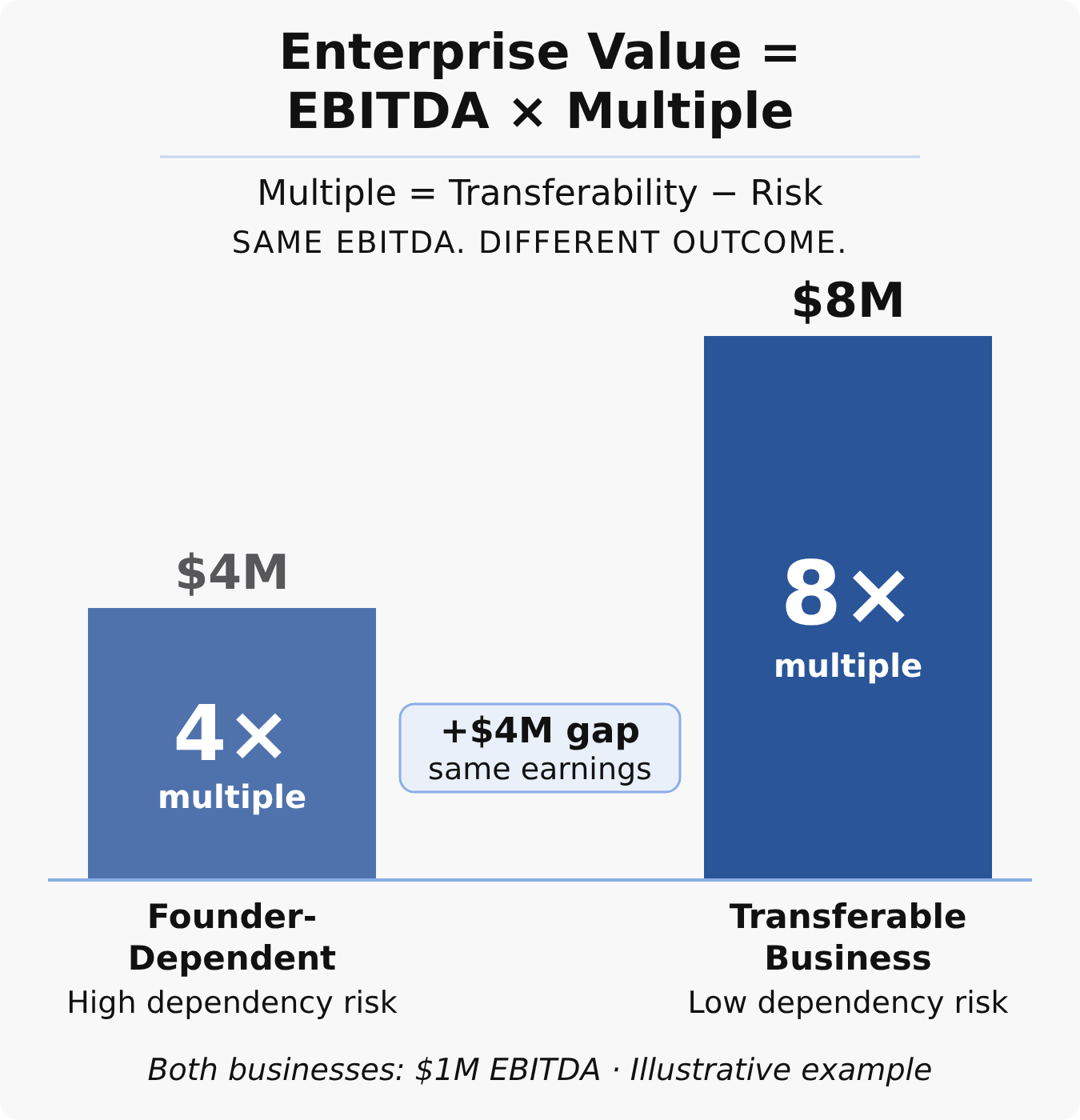
Here’s what happens in due diligence when the business still runs on you. The buyer’s first question isn’t “how is this business performing?” It’s “what happens when this founder leaves?” If the answer requires your continued involvement (transition periods, earn-outs, key-person clauses), they’ve already discounted the multiple. Founder dependency is the most common reason I see a strong business sell at a weak multiple.
You don’t have to sell to benefit from a transferable business, either. You can stay as the architect, step back without stepping out, or sell when the market is ready and the price is right, not when you’re exhausted and need to. For the full picture of the four doors, see Should I Sell My Business? The Four Options Every Founder Has.
How an engagement works
Most of my mid-market work is the Leadership Team Program: the founder and leadership team together, with a one-year minimum. It includes facilitated annual and quarterly planning sessions, regular coaching between them, and ad-hoc calls as needed. Founders who want to start one-on-one can begin with the CEO Program.
Getting started takes two conversations. The first is a discovery call. Before the second, your team completes a Scaling Up assessment, and I read the results back with a recommendation. Sometimes that recommendation is to wait.
I keep the practice small on purpose, with a handful of companies at a time, so availability is limited.
About the author
Herb Cogliano is the founder and executive coach of Aspire Growth Advisors, an executive coaching practice for founder-led companies from $3 million to $50 million in revenue. He is a Certified Scaling Up Coach and a Certified Exit Planning Advisor (CEPA), holds an MBA, and previously taught the Scaling Up Master Business Course. Before coaching, he led his family’s business, Sullivan & Cogliano, through three Inc. 5000 appearances and a 2018 exit. His father founded its staffing company in 1966, and Herb founded its education business in 1993.
Five of his clients have been profiled in Scaling Up’s ScaleUps series with Herb named as their coach: Caring for You, Dragon Edge Group, Treeline, Frozen Drinks Africa and Bright!Tax. His book, Founder Independence, is due in 2027.
Herb works with companies nationwide, mostly in the Midwest and Northeast. Schedule a call with Herb or take the free Scaling Up Readiness assessment.
Frequently asked questions
What does an executive coach do for a mid-market company?
The coach helps the CEO and leadership team run the company on a shared system for strategy, execution and cash, and moves decisions from the founder to the team. The goal is a company that keeps growing when the founder steps back from daily calls.
What are the Rockefeller Habits?
They are Verne Harnish’s checklist of practices for growing companies, including a clear strategic plan, a set meeting rhythm, quarterly priorities with owners and a few key numbers. Scaling Up is the updated version of the same method.
Is Scaling Up the same as EOS?
No. Both give a leadership team a planning and meeting rhythm. Scaling Up goes deeper on strategy and cash, which matters more as a company passes $10 million.
Should a mid-market company hire a coach or join Vistage?
It depends on where the help is needed. A peer group advises the CEO once a month. A coach works with the whole leadership team inside the business. Many CEOs do both.
How long does a Scaling Up engagement last?
Plan on at least a year, and longer for a full handoff, because decisions move off the founder’s desk one function at a time.
Can coaching help us prepare for a sale?
Yes. The work that removes founder dependency is the same work that raises what a buyer will pay.
Under $10 million? Read our guide to scaling past seven figures.
Building a new or growing leadership team? Read what a coach should build in the first 90 days.