
Ask a founder what they want in five years and you often get a shrug. Sell? Hand it to the team or family? Bring in a partner? Keep building? Most haven’t decided, and they don’t have to yet.
What they need is a company that keeps all four doors open.
I give founders options by turning operators into architects. Here’s why that one shift does it.
One question behind every door
Every door asks the same question: does this company run without you?
Sell. If you sell to an outside buyer, the answer decides the price. A business that can’t run without you gets discounted.
Hand off. If you hand it to family, your leadership team or your employees, the answer decides whether you get paid. Insiders usually buy you out over time from the earnings of the business, so a company that still depends on you puts your own payments at risk.
Recapitalize. If you bring in a partner or investor to take money off the table, the answer decides whether they say yes. They want transferable systems and leadership depth, not a founder at the center of every decision.
Architect and scale. If you keep it all, the answer decides whether you get your time back and the room to build what you couldn’t reach while you were holding everything up.
With an outside buyer, dependency costs you price. With an inside buyer, it costs you the payment.
Why independence is worth money
A business is worth its earnings times a multiple, and that multiple is set largely by how transferable and how risky the business is. Two companies can post the same profit and be worth very different amounts, because a buyer pays more for the one they can own and run without the founder in it.
The same million dollars of earnings might trade at four times in a founder-dependent business and eight times in a transferable one. Those multiples aren’t exact. They swing with industry, size and market. But the direction holds.
Three gates
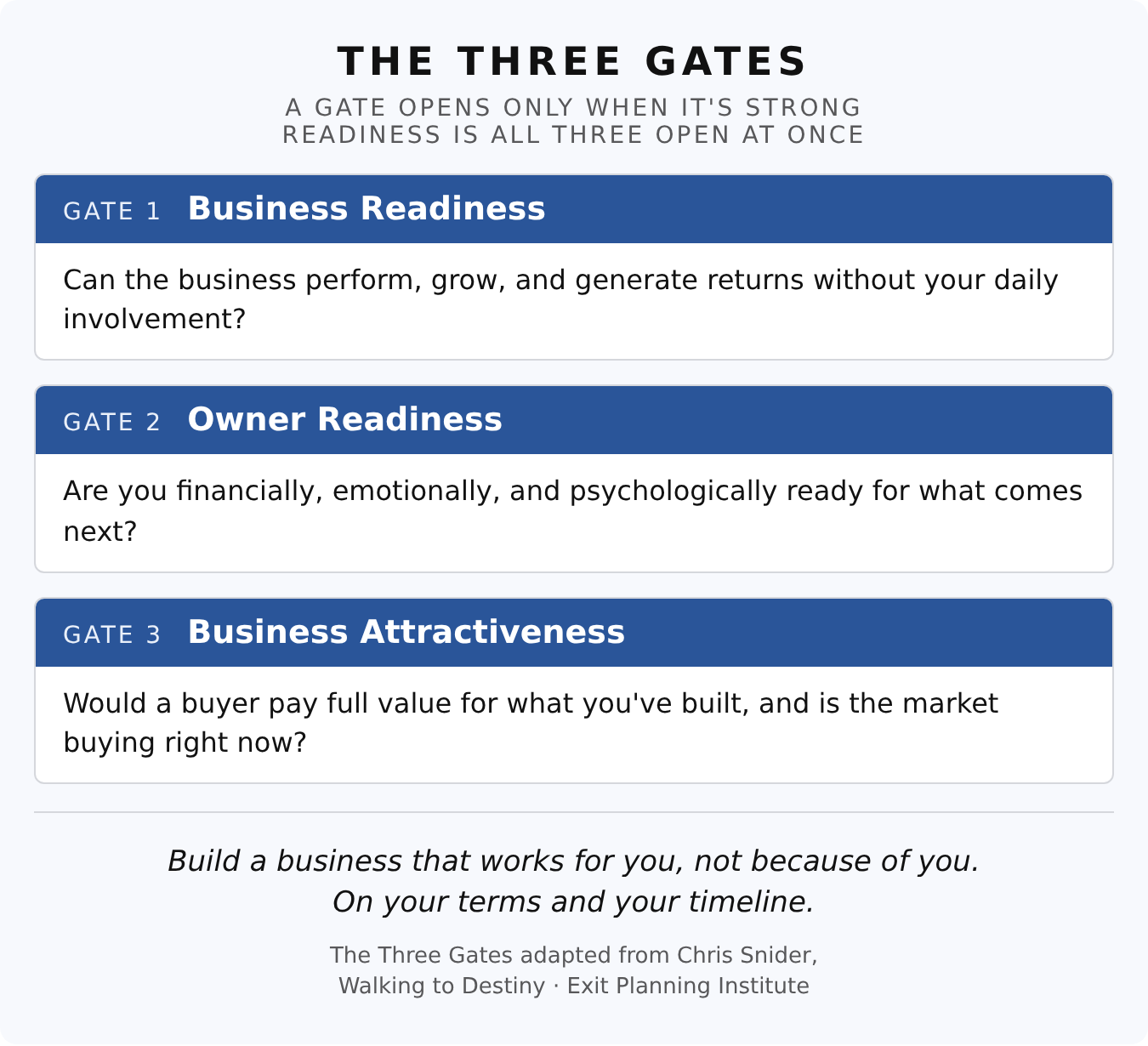
As a Certified Exit Planning Advisor, I look at readiness through three gates. The framework comes from Chris Snider’s Walking to Destiny and the Exit Planning Institute. A company is ready only when all three are open at the same time.
Business Readiness. Can the company perform without you in the daily decisions? This is the gate the rest of my work builds toward: a capable leadership team in all three engines, written decision rights, guardrails, and authority handed over one function at a time. A buyer looks wider than operations, too: documented systems, legal structure, protected IP, and no customer who’s 40 percent of revenue.
Owner Readiness. Are you ready, financially and personally, for whatever comes next? Do you know what a transaction would need to produce to fund the next chapter? Is your estate plan current? Do you know who you are outside the building, and what you’ll do on the Monday morning after you step away? This is the gate founders underestimate most.
Business Attractiveness. Would a buyer, partner or successor want this company at a fair price? Most of this gate is yours to build: loyal and diverse customers, predictable profit and growth, recurring revenue, and low company-specific risk. Only market conditions are outside your control.
When all three are open, every door is open, and you choose. That choice is what I call Founder Independence.
Start with the first gate
Most founders start with the second or third gate. The work is in the first.
- Write down every decision that waited on you last month.
- Give each recurring one an owner, a limit and a check-in point.
- Move each leader through three phases: recommend, then decide, then run it.
The 36-month window
There is a window, roughly 36 months, where the work of Founder Independence and the work of building business value overlap almost completely.
Inside that window, every dollar you invest in leadership capability is also a dollar invested in transferable value. Every decision rights document you install lowers the key-person discount a buyer would apply. Every quarter the company runs without you builds the track record that earns a better multiple.
The founders I’ve watched use this window well don’t have to choose between freedom now and value later. They get both.
You don’t have to sell to be free
Founder Independence creates options: the real ability to choose your next chapter on your own terms.
Some founders clear the three gates and decide to sell. The business is ready, the market is favorable, and they’ve built something worth full value.
Some clear the gates and decide to stay, differently. As the architect. With a team that runs the operation and a founder who leads the strategy.
Greg Dewald, founder and CEO of Bright!Tax, is one of them. By the time his business could run without him, it had cleared all three gates. That readiness gave him what most founders never get: a real choice. He looked at a business he’d made valuable and transferable, and he decided to stay and keep scaling it. Someday the choice may be different, and Bright!Tax will be ready for that day too. Read his story.
Some bring in a partner, recapitalize, or hand the company to family or key employees, with a business that can hold the transfer because the architecture is already in place.
And a business that runs without your daily presence is worth something more immediate to you right now: the time and energy you’ve been giving the operation, back in your hands.
My own version
I took over our family business, Sullivan & Cogliano, the staffing company my father founded in 1966, and in 1993 I founded its education business. For years I was the hub. When I built a leadership team that owned the decisions, we made the Inc. 5000 three times, and in 2018 we had a real choice about what came next.
It was bittersweet. Our team had built an amazing culture and lived our purpose, providing meaningful employment and education opportunities to many people over the years. I wanted to build on that purpose, shaped by the challenges I’d faced as an owner-operator: to stand with founders, believing fiercely in their potential, and to partner in the transformation that creates businesses that scale beyond them and lives that work for them. I didn’t hesitate for a moment. I opened Aspire Growth Advisors in January 2019.
Who this is for
Founder-led companies at $3 million to $50 million, with at least the start of a leadership team. You want to work on the business instead of in it, or you want time back for family, health and the rest of life.
The next move
Ask yourself one question this week: which of the four doors could you walk through today?
If the answer is fewer than four, start with the 5-minute Founder Independence Diagnostic.
The ideas in this guide are in my book, Founder Independence, with a foreword by Verne Harnish, coming in early 2027.
Frequently asked questions
What are a founder’s options for the future of the business?
Four: sell to an outside buyer, hand it off to family, the leadership team or employees, recapitalize by bringing in a partner or investor, or keep it and architect and scale. All four depend on a company that runs without the founder.
Why does founder dependence lower what a business is worth?
A business is valued at its earnings times a multiple, and the multiple drops when the company depends on one person. A buyer pays more for a company they can run without the founder in it.
What are the three gates of exit readiness?
Business Readiness (the company performs without you), Owner Readiness (you’re ready financially and personally) and Business Attractiveness (a buyer or successor would want it at a fair price). The framework comes from Chris Snider and the Exit Planning Institute.
Do I have to sell my business to step back from it?
No. Many founders build a company that runs without them and then choose to stay as the architect, leading strategy while the leadership team runs the operation. The point is having the choice.
How long does it take to get ready?
Usually about three years. The work of making the business independent and the work of building its value overlap almost completely over that 36-month window.