
Most founders I work with already believe good leaders let go. Give people room. Let them make decisions. On the surface, that sounds right.
But letting go without the right structure and graduated authority carries a lot of risk. Hand a leader full authority on a Monday, and by Thursday something wobbles. By the following Monday, the founder is back in the seat they just handed off, now convinced the whole exercise proved they were indispensable.
It wasn’t proof.
It was bad sequencing.
Letting go without the structure underneath it has a name: abdication.
Abdication looks like delegation
Abdication has the same language as delegation, the same announcement, the same org chart update. The difference is in the sequencing.
Abdication transfers full authority before you have evidence the person can hold it. The leader is left to figure it out on their own. When they struggle, you read it as a failure of the person rather than a failure of the handoff.
Functional Expansion is the alternative. You transfer authority in deliberate stages, in layers that expand as the leader shows they can hold what they’ve been given. The function stays the same. The accountability stays the same. The evidence required changes with every stage.
That’s the difference between a handoff that sticks and one that collapses the moment pressure arrives.
Build the architecture first
The bridge from a founder-dependent company to one that runs without you gets built one decision at a time. In writing. By function.
You build that authority architecture in three stages, each resting on the one before it.
FACe, the Function Accountability Chart. One accountable leader per function. One name, one seat, one owner. If your org chart doesn’t pass this test, decision rights don’t matter yet. You have a structural problem to fix first.
Decision Rights, in writing, function by function. For each function, a one-page document with three categories: Fully Owned (the leader decides and acts without checking with you), Consult (the leader seeks your input first but keeps the final call) and Approval Required (the leader needs your sign-off, usually because the decision crosses a financial threshold, carries real risk or affects the whole company). The default rule: if a decision isn’t listed, the leader owns it.
Guardrails. The measurable limits that make handing over authority safe. They tell everyone in advance what will bring you back in. Add one rule on top: No Surprises. Leaders escalate early if a decision could materially hit cash, customers, people, legal or reputation.
Most founders get this wrong in one of three ways. They try to do every function at once. They write it down but don’t share it. Or they share it and then undermine it the first time someone makes a decision they wouldn’t have made.
The discipline is a single-function rollout. Pick your strongest engine seat, build the pattern right, and let that leader run with written authority first. Then replicate.
The three phases
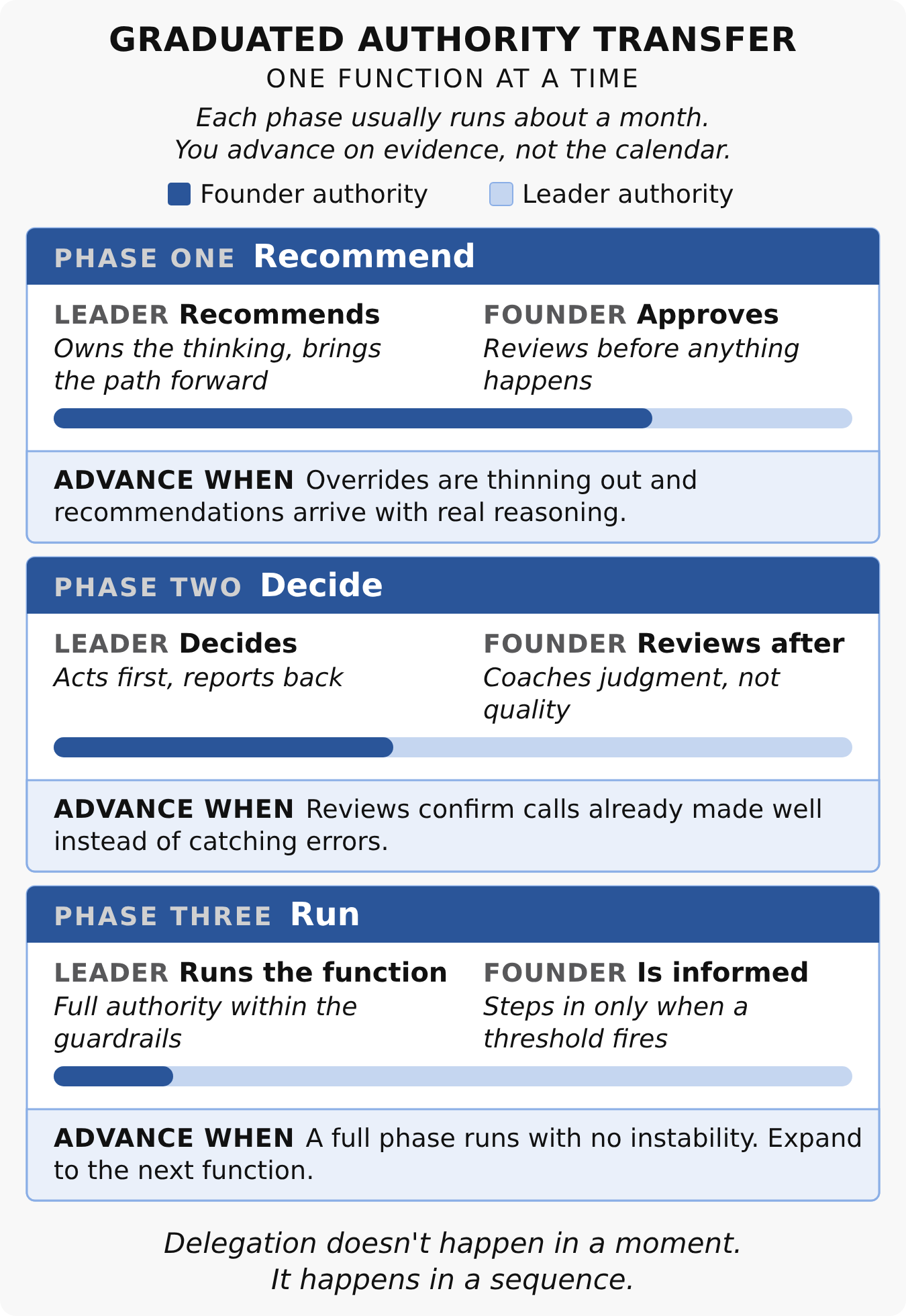
Authority matures through three phases, each usually about a month.
Phase One, Recommend. The leader recommends, and you approve. They own the thinking and bring you the call; you review before anything happens. If you override, explain why. That explanation builds judgment. Your job this month is to see how the leader thinks.
Phase Two, Decide. The leader decides, and you review after. Coaching, not correcting. Your discipline gets harder here: you don’t review before the decision is made.
Phase Three, Run. The leader runs the function within the guardrails, and you’re informed. You step in only when a threshold fires. This is the destination.
Advance when the evidence supports it, whether that takes three weeks or six. If performance wobbles, you hold the phase.
The One Quarter Rule
Here’s where most handoffs go wrong.
Founders move leaders up based on tenure, relationship or optimism. They’ve been here long enough. They’ve earned it. I think they’re ready.
None of those are evidence.
The One Quarter Rule: a function moves on only after it has run a full quarter of consistent, accountable performance at its current level. Ninety days is long enough to see a leader under real pressure: the hard weeks, the difficult client, the team conflict that doesn’t resolve cleanly.
A quarter gives you signal. A week gives you a sample.
Once one function has held for a quarter, you start the next.
Four numbers to track every week
- Escalations. They should decline month over month. If they don’t, your guardrails may be too narrow.
- Founder overrides. High in the first month is normal. High in the third month means the system isn’t holding.
- Performance stability. The function’s metrics have to hold. Advance only when they do.
- Founder re-entry. If you keep getting pulled back in, trace it: a capability gap, a guardrail gap, or your own reflex?
These four are your dashboard. Without them, you’re guessing.
When it wobbles
Somewhere in here, a function will probably wobble at least once. A decision comes back to you that shouldn’t. A metric slips. Your instinct will be to yank authority back. Diagnose before you touch anything, and check in this order.
Start with your role. Did you actually transfer the authority, or are you still in the loop, second-guessing and hovering? A leader who senses the founder still deciding in the shadows stops deciding.
Next, check clarity. Were the outcomes and guardrails written down, or were some still living in your head? A leader can’t hold a line they can’t see.
Only then question capability, and judge it on the record of a quarter, not the mood of a bad week.
Whatever the cause, step back a phase. A Phase Two wobble returns to Phase One. The phases exist so a setback only costs you a month.
The founder’s reflex
The handoff isn’t the hard part. The reflex is.
You hand something off. You stay out. Then something wobbles: a missed deadline, a client complaint, a team member who goes around the leader and comes straight to you.
Your hand goes for the wheel.
Every founder has this reflex. It formed because for years, reaching for the wheel was the right call. It kept the business alive. It fades as the architecture makes it unnecessary.
When FACe, Decision Rights, the three phases and the No Surprises rule are all in place, the wobble still happens. But you hear about it from the leader, not the client. And the leader handles it.
Two habits help. Stop co-signing decisions your leader has already made. And before you share your answer, ask, “What would you do?”
One founder’s transfer
A founder I work with had done everything right on paper. He’d promoted his ops leader, changed the org chart and stepped back.
Three weeks in, a client issue surfaced. He found out from the client, not from his ops leader. His first move was to handle it himself. His second was to wonder whether the promotion had been a mistake.
It wasn’t a mistake.
It was a missing structure.
We moved his ops leader back to Phase Two, with a clear 90-day window and explicit reporting expectations. We put the No Surprises rule in writing so both of them understood what running the function actually required.
One quarter later, his ops leader moved to Phase Three on her own evidence. She’d earned it, and he knew it because the quarter said so.
Run the test this week
Map where each of your key leaders sits today: Phase One, Phase Two or Phase Three. If you’re honest, most are floating somewhere between phases, with no defined criteria for what moves them forward.
Then ask your strongest leader to list 5 decisions they own outright. If they can’t, start with the architecture.
Authority is real when your leader makes a Fully Owned decision without telling you, you find out later and you’re fine with it, and you don’t override it, even when you disagree. That last one is the founder’s discipline, and it’s the hardest part. Authority that gets overridden once stops being authority.
For a fuller picture of where you stand, take the 5-minute Founder Independence Diagnostic.
The ideas in this guide are in my book, Founder Independence, with a foreword by Verne Harnish, coming in early 2027.
Frequently asked questions
How do I delegate authority without losing control?
Build the structure first: one accountable leader per function, written decision rights, and guardrails that say when you step back in. Then hand over one function at a time through three phases (recommend, decide, run), and move on only after a full quarter of stable results.
What is graduated authority?
A way of transferring control in stages. The leader first recommends and you approve, then decides and you review after, then runs the function while you’re informed. Each phase usually takes about a month, and the leader advances on evidence, not the calendar.
What are decision rights?
A one-page list for each function that sorts decisions into three categories: Fully Owned (the leader decides alone), Consult (the leader asks for your input but makes the call) and Approval Required (the leader needs your sign-off). Anything not listed is Fully Owned.
How long does it take to hand off a function?
About a quarter per function, moving one function at a time. If a function wobbles, it steps back a phase, so some take longer than 90 days.
What should I do when a leader struggles after I hand off authority?
Diagnose before you take anything back. Check your own role first, then whether the outcomes and guardrails were clear and in writing, and only then the leader’s capability. Whatever the cause, step back one phase and try again.