
The business is ready. The leaders are capable. The authority is transferred. And you still can’t fully let go.
I’ve watched this happen enough times to stop being surprised by it. The founder has done the work. Built the team. Defined the decision rights. Installed the guardrails. And then they find a reason to get back in.
A client meeting they “should” take. A decision that “really needs” their read. A hire the VP could make but somehow still lands on the founder’s desk. The architecture is holding. Something else is pulling them back. Something the structural work was never designed to fix.
Why the business becomes who you are
For most founders, the business didn’t start as a job.
It started as a calling. You built something from nothing. Carried it through the hard years. Made payroll when you shouldn’t have been able to. Solved problems no one else could solve because you were the one who cared most.
For a long time, the business ran on you because it had to. The problem is what happens after. After the team is built. After the architecture is in place. The business no longer needs you the way it once did. But you still need it. Not the revenue. Not the title. The identity.
The feeling of being the person this all depends on. The confirmation that what you built couldn’t exist without you.
That’s the Identity Trap. The fourth of the six dependency traps in founder-led businesses, and by far the most invisible.
You can name the Talent Trap. Fix the Clarity Gap. Transfer authority to three capable leaders. But if your identity is fused to the business, none of that gives you freedom. Because underneath the structure, part of you doesn’t want it.
The five signals
See how many of these land.
- You celebrate when things run without you — but quietly hope it won’t work too well. If it works perfectly without you, who are you?
- You describe yourself as your company. “I’m a $20M services business founder.” Not: “I’m someone who built a $20M services business.” The fused identity shows up in the grammar.
- You get back into decisions you’ve already delegated. Not because the leader got it wrong. Because watching from the sideline doesn’t feel right yet.
- You feel guilty when you’re not working. Freedom arrives and immediately appears negligent.
- You can’t describe your “next” with any specificity. When the answer to “what would you do with your time?” is “travel more” or “spend more time with family,” the Identity Trap is still active.
Independence requires a TOWARD, not just an away-from. Most founders I work with land on at least two. Some land on all five and don’t say so out loud.
What the Architect shift actually requires
The structural work in Founder Independence is buildable. There’s a sequence for leadership density, authority architecture, guardrails, and functional expansion. I can show a founder exactly what to do.
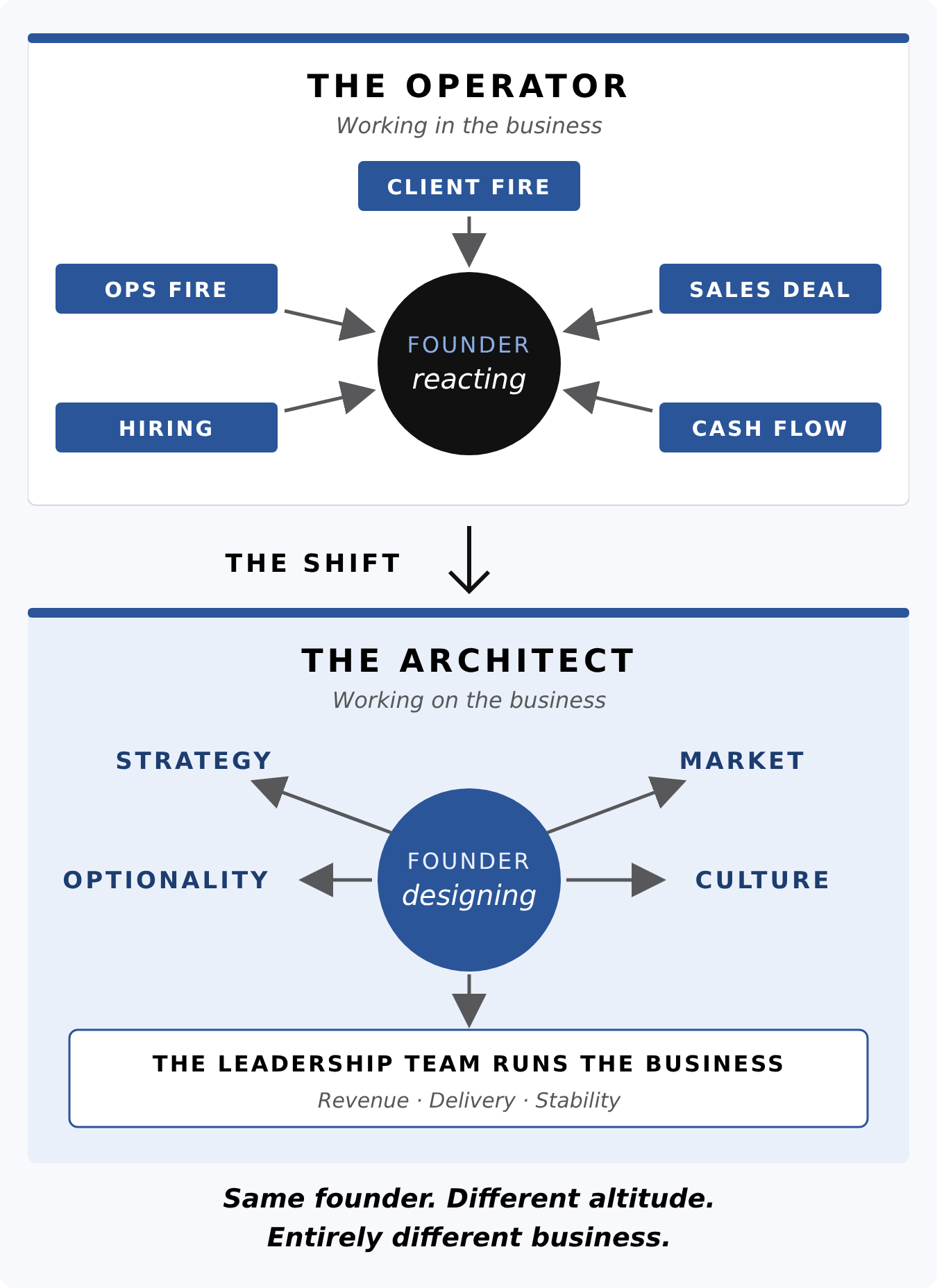
The Operator-to-Architect shift is harder. The Operator runs the business. Makes decisions. Carries the load personally.
The Architect designs the business. Builds the leaders who run it. Shows up for the 20% that genuinely requires the founder. Different job. Same person. Here’s where the stall happens. The shift isn’t just a new set of tasks. It’s a new relationship with your own value.
For 10 or 15 years, your value has been what you know and what you decide. As an Architect, your value is what you build and who you develop. That’s a deeper rewiring than a change in job description.
The one question
Before I start any independence engagement, I ask a version of this: If the business ran completely without you tomorrow — what would you do with Tuesday afternoon? Not vacation. Not retirement. Tuesday afternoon.
Most founders pause. Some laugh. A few say they have no idea. That pause is information. Vague answers mean the identity work hasn’t started. “Travel more” is a direction. The architecture gives you the freedom. The identity work tells you what to do with it. Both transformations are required.
I’ve seen founders build clean architecture and drift back into the business six months later. Not because the guardrails failed. Because they hadn’t done the personal work of deciding what they were building toward.
The Architect needs a design for the business. Yes. They need a design for themselves, too.
The Identity Trap isn’t the last obstacle. It’s the last piece of the architecture. And it has a solution.