
There’s a question I ask every founder I work with. Not at the end of our engagement — at the very beginning.
If you stepped away from your business for 90 days, would performance hold — or would it slow down?
I call it the Mirror Question. The answer reveals more about a business’s architecture than any financial statement, any org chart, or any leadership assessment.
The two stages of every founder-led business
Most founder-led companies move through two distinct stages.
The first stage is survival. The founder is the engine. Every decision, every client relationship, every operational judgment runs through them because they’re the only one with full context. This is appropriate. It’s how companies get traction.
The second stage is scale. Revenue grows. The team grows. Complexity compounds. But the decision routing often stays the same. Everything still flows back to the founder.
This is the architecture gap — the space between where the business has grown and where the structure has kept pace.
In the scale stage, the founder-as-system stops being a feature and becomes a constraint.
Why growth makes it worse — not better
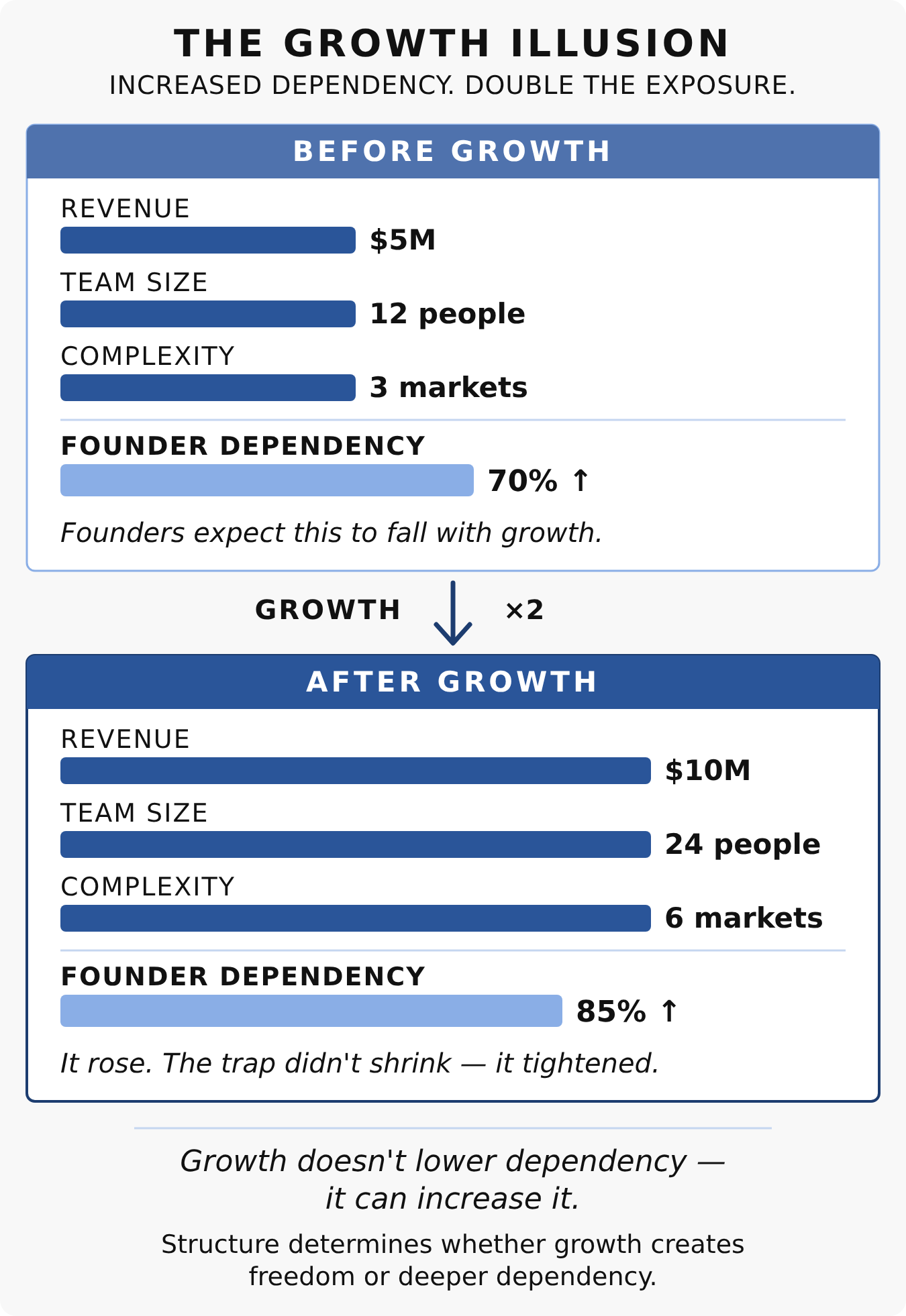
Most founders believe growth will eventually solve this. More revenue means more resources. More resources mean I can hire my way out. Once we hit $20M, this gets easier.
It doesn’t.
Growth amplifies whatever structure already exists. If your systems are strong, growth accelerates them. If your decision-routing is weak, growth makes it weaker.
A founder-dependent business at $10M is more founder-dependent at $20M — not less. More revenue creates more decisions. More decisions route back to the founder. The dependency deepens with every milestone.
This is the Growth Will Fix It Illusion — and it’s one of the most expensive beliefs I see in founder-led businesses.
The architecture of independence
Founder Independence is not grown into. It is not delegated into. It is not scaled into.
It is architected — deliberately, structurally, and with patience.
It means installing: the leadership density to have A-players in every core seat; the decision rights that tell each leader exactly what they can decide without escalation; the guardrails that make autonomy safe; the graduated expansion of authority based on evidence.
When that architecture is in place, three things happen simultaneously:
The founder gets their time back — not by stepping away, but by leading at altitude.
The team becomes genuinely capable — because authority is real, not performed.
The business becomes more valuable — because buyers pay for transferability.
What the Mirror Question is really asking
The 90-day question isn’t asking whether you’re needed. Every founder is needed.
It’s asking whether the business performs because of what you’ve built — or in spite of your absence.
That distinction is the architecture gap. And closing it is the work of Founder Independence.
If that question created a knot in your stomach — that’s the signal. That’s where the work starts.