
Real autonomy isn’t unlimited authority. Here’s the principle that makes it work.
There’s a moment every founder describes the same way.
A leader they trusted made a significant decision. It landed wrong.
Not a catastrophic decision. Not even necessarily a bad one in isolation.
But it surprised the founder. And in the moment of surprise, something shifted.
The founder pulled back authority. The leader felt the contraction. The cycle of dependency reset — not because of a bad decision, but because of a missing guardrail.
This is the most common way founder-led businesses fail to hold independence after they’ve built it.
Not because of capability. Not because of intentions. Because the edges of authority were never defined.
The guardrail principle
Here’s what I know after years of building independence systems:
Authority without guardrails isn’t freedom. It’s uncertainty wearing the mask of freedom.
Real autonomy — the kind that compounds and expands over time — requires clear operating thresholds. Not restrictions on what leaders can do. Definitions of when they need to involve the founder before acting.
The formula is this:
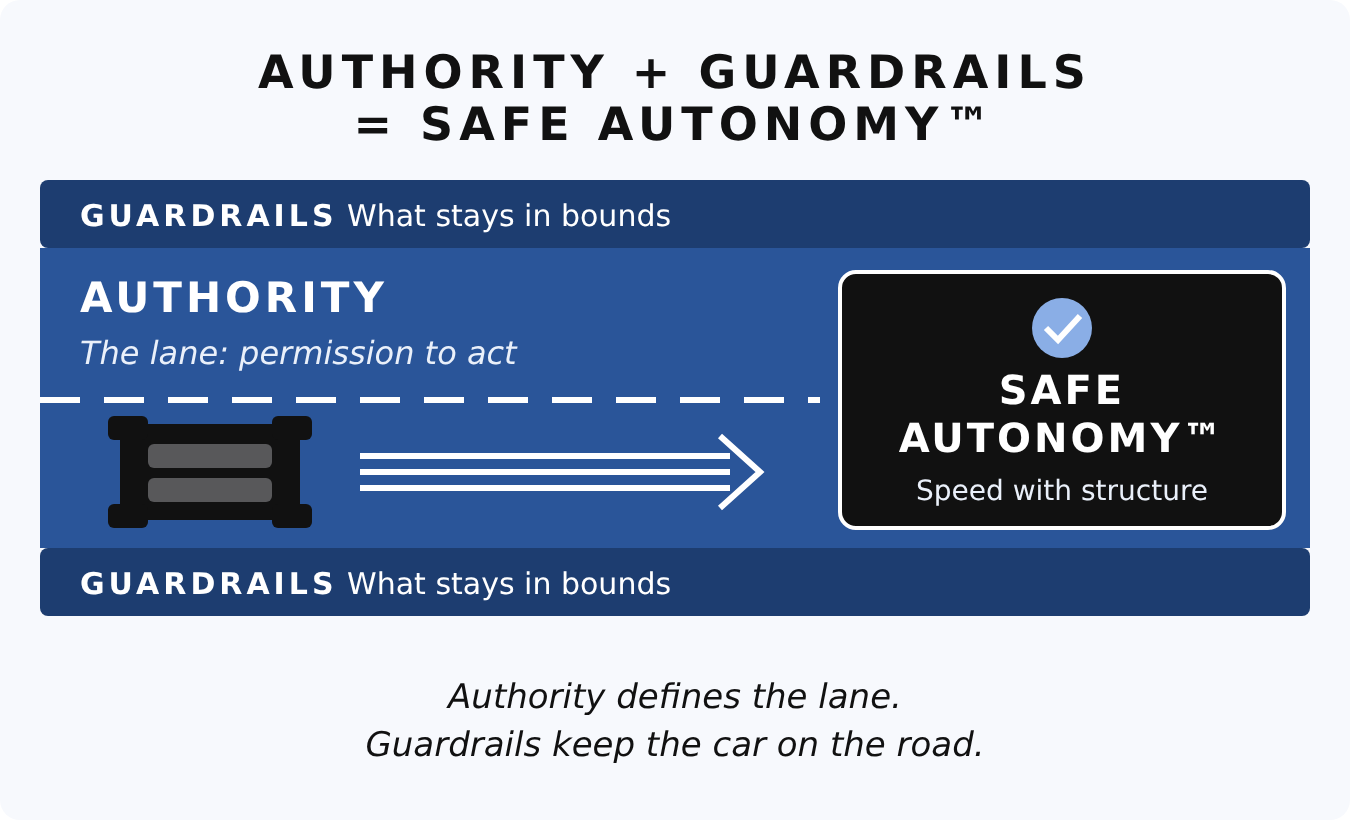
Authority + Guardrails = Safe Autonomy
Think of guardrails the way you’d think of a highway guardrail. They don’t limit your speed. They make high speed safe. Without them, everyone slows down — because the risk of going fast without a margin for error is too high.
With guardrails in place, leaders can move at full speed within their function. They know exactly where the edge is. And because they know, they don’t have to hesitate.
The No Surprises Rule
At the center of every guardrail system is one principle I call the No Surprises Rule.
Your leaders can make decisions. They can own outcomes. They can act with genuine authority.
But they cannot surprise you with something that materially affects the business — without prior notification.
This isn’t permission-seeking. It’s intelligence-sharing.
The No Surprises Rule defines what triggers an escalation: not to seek approval, but to keep the founder informed before a threshold situation becomes a crisis.
The four thresholds
In practice, most businesses need guardrails in four core areas:
- Revenue Variance — below what percentage of plan does the head of sales flag the founder?
- Margin Compression — at what margin erosion level does finance notify leadership?
- Cash Risk — what cash balance or AR aging level requires escalation before a covenant is at risk?
- Talent Instability — when does a key player’s flight risk require founder-level visibility?
These aren’t arbitrary. They’re calibrated to the specific risk tolerance and cash dynamics of the business.
But here’s what I want you to take from this:
The most dangerous number in a guardrail system isn’t the threshold. It’s the absence of one.
When leaders don’t know the edges, they guess. Some guess too conservatively — and escalate constantly. Others guess too aggressively — and surprise the founder with something that shouldn’t have been decided alone.
Define the edges. Publish them. Review them quarterly.
The two cadences
Once guardrails are defined, they need a rhythm. Two rhythms, actually.
A weekly pulse — short, data-driven, focused on early warning signals. If everything is inside the guardrails, the meeting is fast. If a threshold is approaching, that’s the conversation.
A monthly review — deeper, forward-looking, strategic. Where is the business relative to plan? What’s the trajectory on margin, talent, and cash?
Together, these two cadences create a system of visibility that doesn’t require the founder to be present for daily operations — because the system itself is watching.
That’s Safe Autonomy.
Not unlimited authority. Not micromanagement wearing the disguise of structure.
Real authority, with real edges, producing real trust.