
Most founder exits don’t fail at the negotiating table. They fail in the diligence room three months later. The number was right. The strategic fit was real. The business had performed for 15 years. And somewhere around week 4 or 5 of due diligence, the conversation changed. “We’d need you to stay for 36 months.” “There’s a key-person risk we’d need to price in.” “Can you walk us through which decisions your leadership team makes independently?” These aren’t dealbreakers automatically. But they’re signals. And sophisticated buyers price signals. I call this the Options Trap. The fifth of the six dependency traps in founder-led businesses — and the one that costs founders the most. Not in their daily work. In the moment they finally want something different.
What the discount looks like
A founder-dependent business and a transferable business can look identical from the outside. Same revenue. Same team. Same market position. Same 15 years of performance. One gets a premium multiple. The other gets a discount, a long earnout, or a pass. The difference is what happens when the founder isn’t in it. Buyers aren’t paying for what you built. They’re pricing the transition risk. What does the revenue look like in year 2, when you’re out? Do the clients stay? Does the team perform? If nobody can answer that question with evidence — with actual proof the business has operated without the founder — that uncertainty goes somewhere. Into the offer price. Into the structure. Into whether there’s an offer at all. Not a character judgment. A structural one.
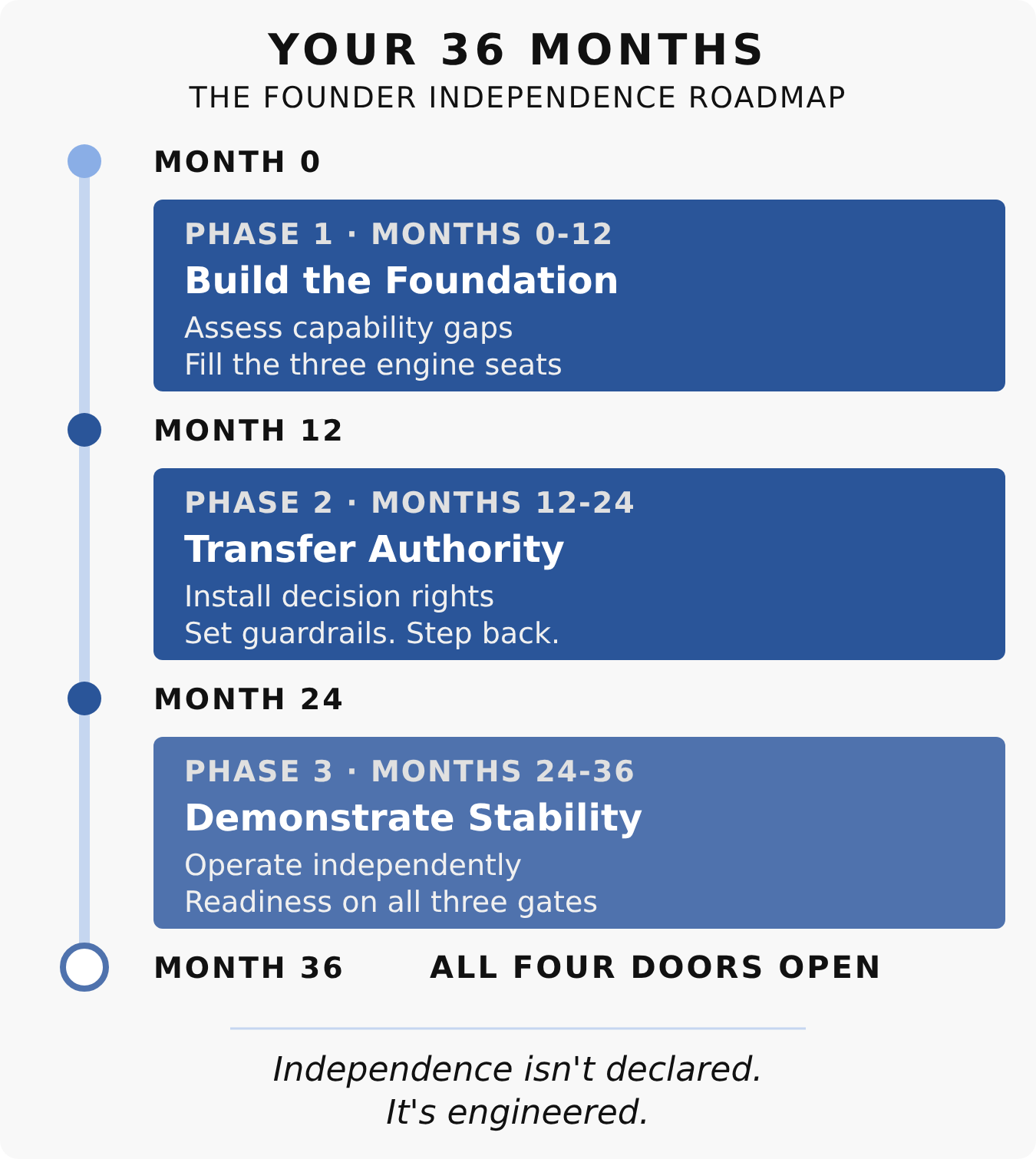
The 36-Month Window
Most founders I talk to want options in the next 5 years. Here’s the problem. The window where independence work and market value work are the same work isn’t 5 years. It’s 36 months. Inside that window, everything compounds. Every capability you build into your leadership team reduces your dependency discount. Every Decision Right you transfer to a leader becomes documented proof of independence. Every quarter your business performs without you in the room is evidence a buyer can point to. The founders who keep their options open don’t start building when the first call comes from a buyer. They started 3 years earlier. And here’s what most people miss: the work is identical whether you sell, hand off, recapitalize, or architect and scale. Not exit planning. Independence planning. The exit, when you want it, is the reward. Waiting doesn’t preserve your options. It closes them.
What sophisticated buyers actually evaluate
PE firms and strategic buyers run different processes, but they’re asking the same underlying question: does this business perform because of its architecture, or because of this founder? Here’s what that question looks like in a diligence meeting. First, decisions. Who makes them, at what threshold, and whether there’s documentation or whether it lives in the founder’s head. “We trust our team” is not an answer a buyer can put in a model. Second, client relationships. Are key accounts institutional — owned by account leads with documented history — or personal? Relationships that move with the founder are priced accordingly. Third, performance without the founder present. Not for a week. A quarter. Were the metrics held? Did the team operate? Is there evidence, or is there faith? Fourth, the leadership team. A-level leaders in the three engine seats — Revenue, Delivery, Stability — each with a track record of independent performance. Or not. The founders who get clean offers have answers to all four. Documented answers. Not anecdotes.
The architecture that opens your options
Build the architecture for yourself, not for a buyer. A buyer is simply the person who eventually pays for what you built. The Three Gates to a market-rewardable exit: Business Readiness. Owner Readiness. Business Attractiveness. Most founders think about Business Attractiveness first. The multiple. The timing. The sector trend. They read articles about what the market is doing and wait for the right window. The gate that’s actually in their control — and the one that moves the other two — is Business Readiness. A business that runs without you is a business a buyer can price. The market rewards what can run without you. So build the leadership team. Define the Decision Rights. Install the guardrails. Document the proof of independence. Not because a buyer is watching. Because the business should work that way regardless. If a sale follows, the architecture was already there. If it doesn’t, you’ve got your time back. Either way, you win.
Exit doesn’t have to mean leaving. It means having the choice. That choice is built now, in the 36 months before you need it.