
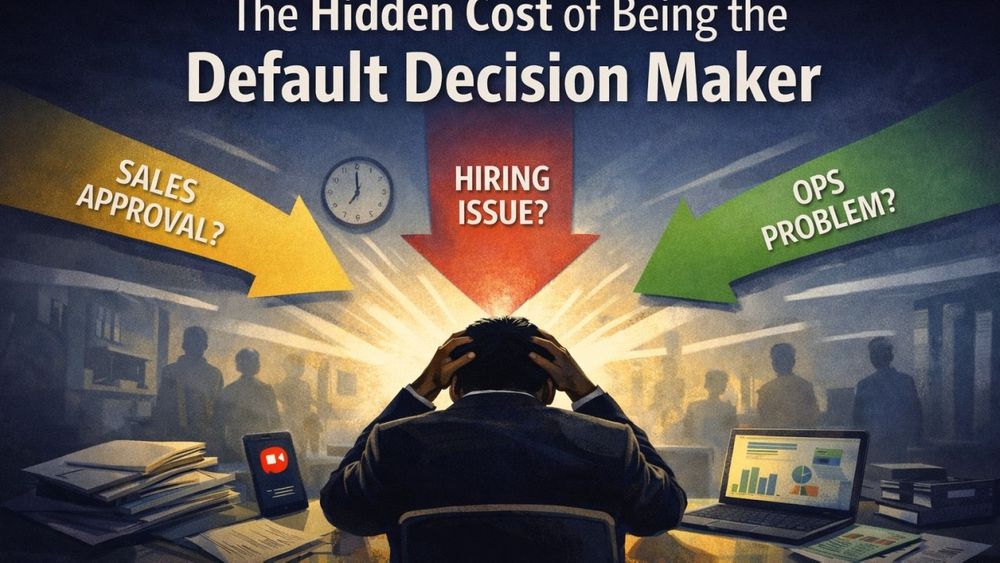
Every growing company hits a stage where the founder becomes the safest answer.
Big deal? Ask the founder. Hiring question? Ask the founder. Pricing exception? Ask the founder. Operational issue? Ask the founder.
It feels responsible.
It’s not.
Being the default decision maker creates three hidden costs:
1. Decision Latency Everything slows down because the business waits for one person.
2. Leadership Atrophy When leaders escalate instead of deciding, judgment weakens. Muscles not used don’t strengthen.
3. Cognitive Overload The founder becomes the integration point for every function — and starts mistaking activity for leverage.
At first, performance doesn’t drop.
In fact, it often improves.
Because the founder is good at making decisions.
But scale doesn’t break when decisions are wrong.
It breaks when decisions can’t be made without you.
The companies that grow beyond $10M, $20M, $50M don’t remove the founder.
They redesign authority.
They define:
- What is owned.
- What escalates.
- What never escalates.
- When intervention is required.
Trust doesn’t create independence.
Structure does.
And once structure exists, trust follows naturally.
The shift from operator to architect is rarely dramatic.
It’s quiet.
It happens the moment the founder stops being the safest answer in the room.