
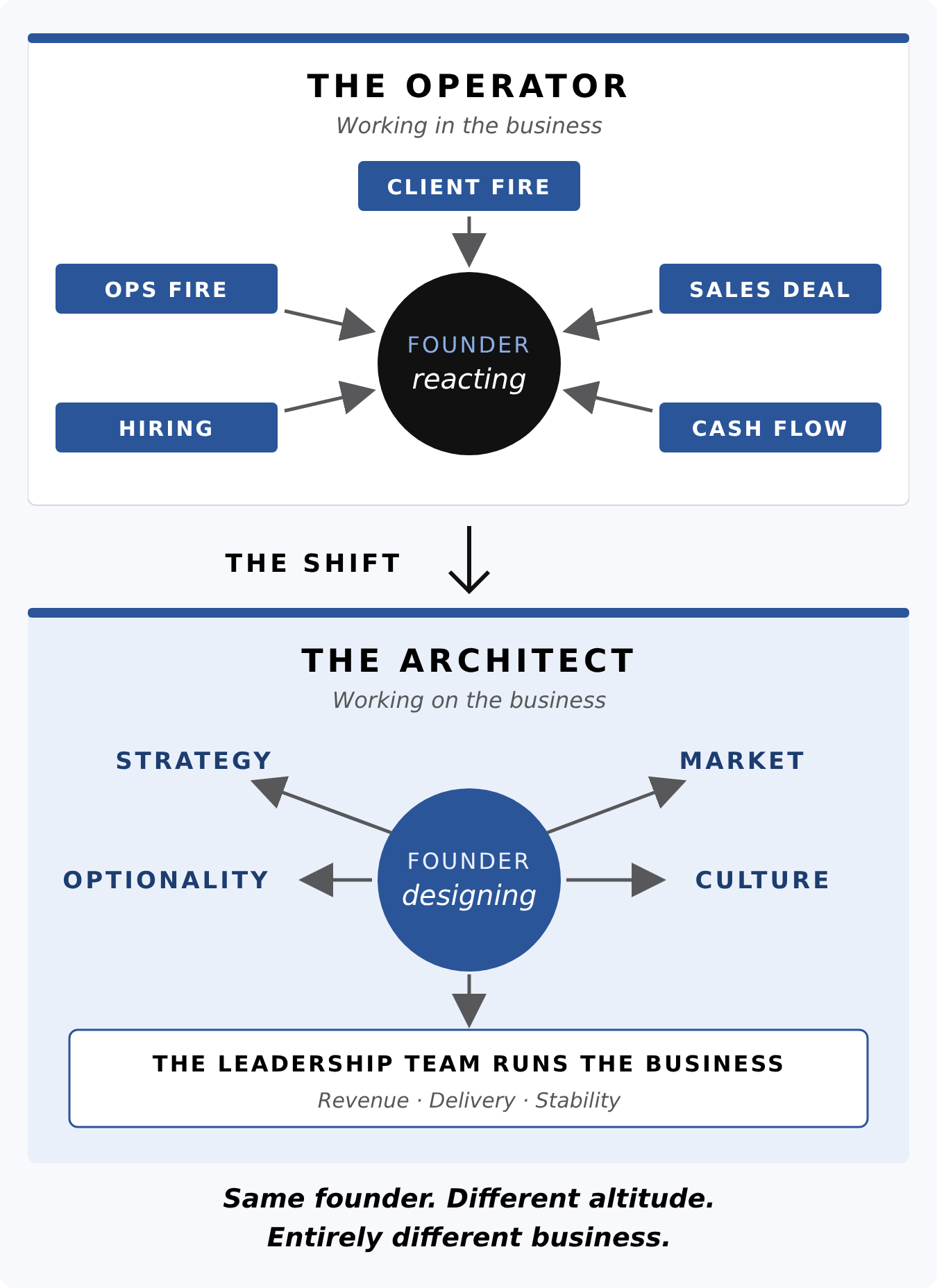
Most growing companies don’t fail - They stall.
Revenue increases. Headcount grows. The market responds. And yet, somewhere along the way, the business starts to feel heavier instead of freer.
Decisions slow down. Leaders hesitate. The founder feels more needed than ever.
What’s happening isn’t obvious — and that’s the problem.
The shift no one plans for
In the early stages of a company, founder involvement is an advantage. Speed matters. Judgment matters. Context lives in one head.
But as the business grows, the same behaviors that once drove momentum begin to create dependency.
Not because the founder is controlling. Not because the team isn’t capable.
But because the company was never redesigned for the next stage.
Most founders assume the answer is better delegation.
It rarely is.
Why delegation doesn’t hold
Delegation fails not because work doesn’t move down — but because decisions don’t.
Tasks are assigned. Authority is implied. But accountability remains unclear.
So leaders execute… then wait. They seek confirmation. They escalate uncertainty. Over time, important decisions drift upward — not by intent, but by default.
The founder becomes the integrator of last resort.
When growth creates weight
This is the moment many founders misdiagnose the problem.
They think they need:
- Better people
- More discipline
- More effort
What they’re actually experiencing is a design problem, not a motivation problem.
When decision rights are unclear, leaders hesitate. When cadence is inconsistent, issues surface late. When strategy lives in one head, execution depends on one person.
Growth continues — but freedom disappears.
I watched this happen to a founder who grew his services company from $5 million to $14 million in five years. His team went from 10 people to 50, and his markets went from one city to four. Every win made him more necessary, not less. He kept saying he’d build the team once he hit the next number: first $7 million, then $10 million, then $20 million.
I fell for it too. We made the Inc. 5000, and growth made me more central to the business than I had ever been.
The real choice
Every growing company eventually faces a quiet decision:
Remain indispensable… or design the business to operate without you.
Founder independence isn’t about letting go. It isn’t about working less.
It’s about building systems that allow the company to scale beyond the founder.
Most founders don’t realize when this shift happens. They only feel the weight once it’s already there.
And by then, effort won’t fix it.
Only design will.