
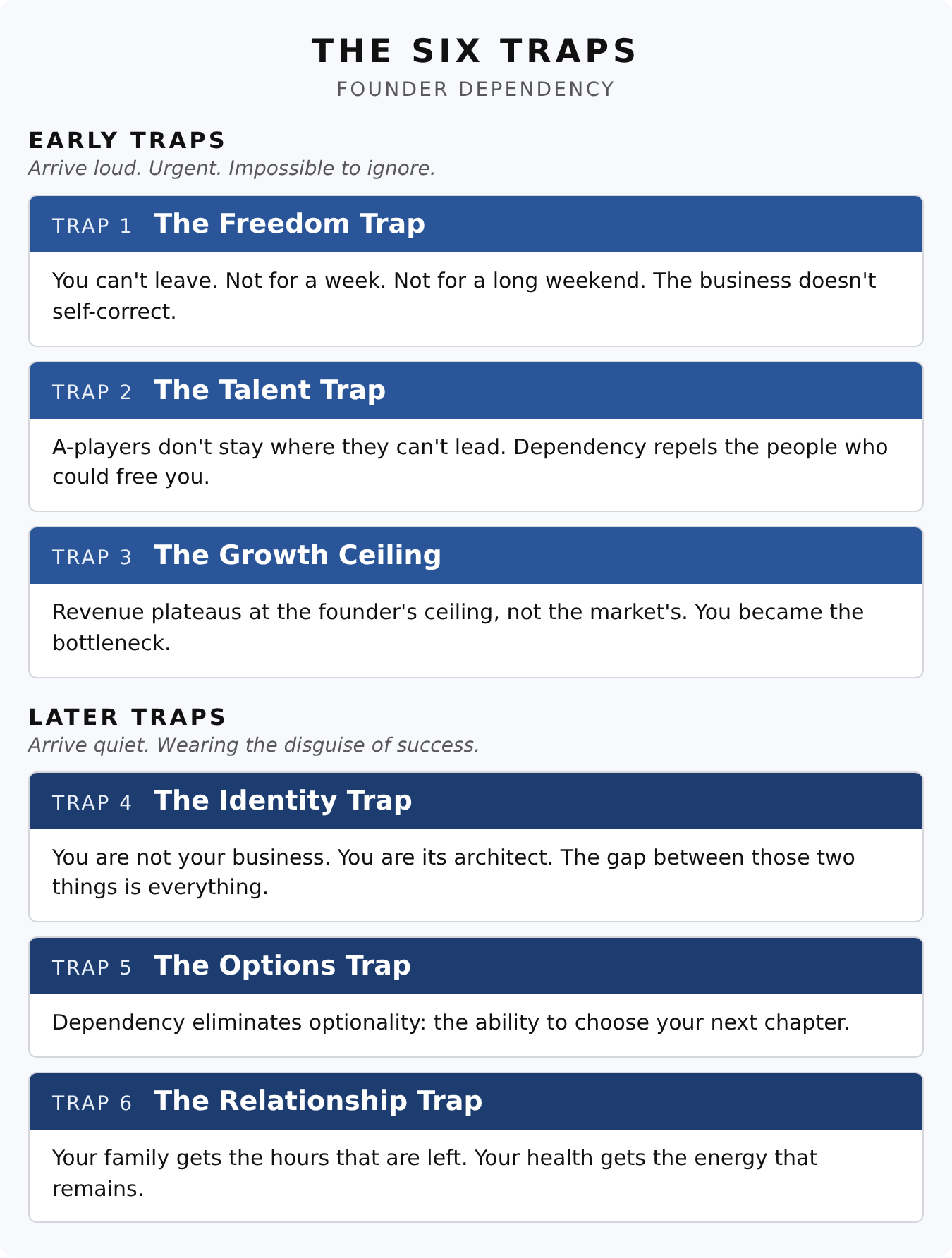
It’s not compensation. It’s not culture. It’s authority architecture.
The Talent Trap
The strongest leader who left your business in the last few years probably didn’t leave for more money.
They left because they couldn’t fully lead.
Most founders don’t see it happening. The departure comes as a surprise. The exit interview is polite. But somewhere in the year before they resigned, there was a moment — maybe many moments — where they stopped feeling like they had real authority.
Escalations kept flowing up. Decisions kept routing back to the founder. The team kept waiting for direction. And your best person quietly concluded: this is a ceiling, not a platform.
I call this the Talent Trap. It’s the second of six dependency traps in founder-led businesses — and it’s the one that does the most long-term damage, because the people it costs you are the ones you most needed to keep.
The painful irony: the founders who most need great leaders around them are the same founders whose structure drives great leaders away.
Not because they’re bad leaders. Because they haven’t built the architecture that lets great leaders actually lead.
A-players don’t need unlimited authority. They need defined authority — clarity about what they can decide without escalation, real decision rights, and genuine accountability for outcomes.
Build that, and strong leaders stay and grow. Skip it, and you’ll keep replacing the same seats.
The question
Think about the strongest leader who has left your business in the past three years.
What was the real reason they left? Not the official story — the real one.
Was there a moment where they stopped feeling like they could fully lead?
One move
This week: have one conversation with a current leader on your leadership team about decision authority.
Ask them directly: “Are there decisions you feel you should be able to make independently that still route through me?”
Their answer will tell you more about your talent architecture than any exit interview ever will.