
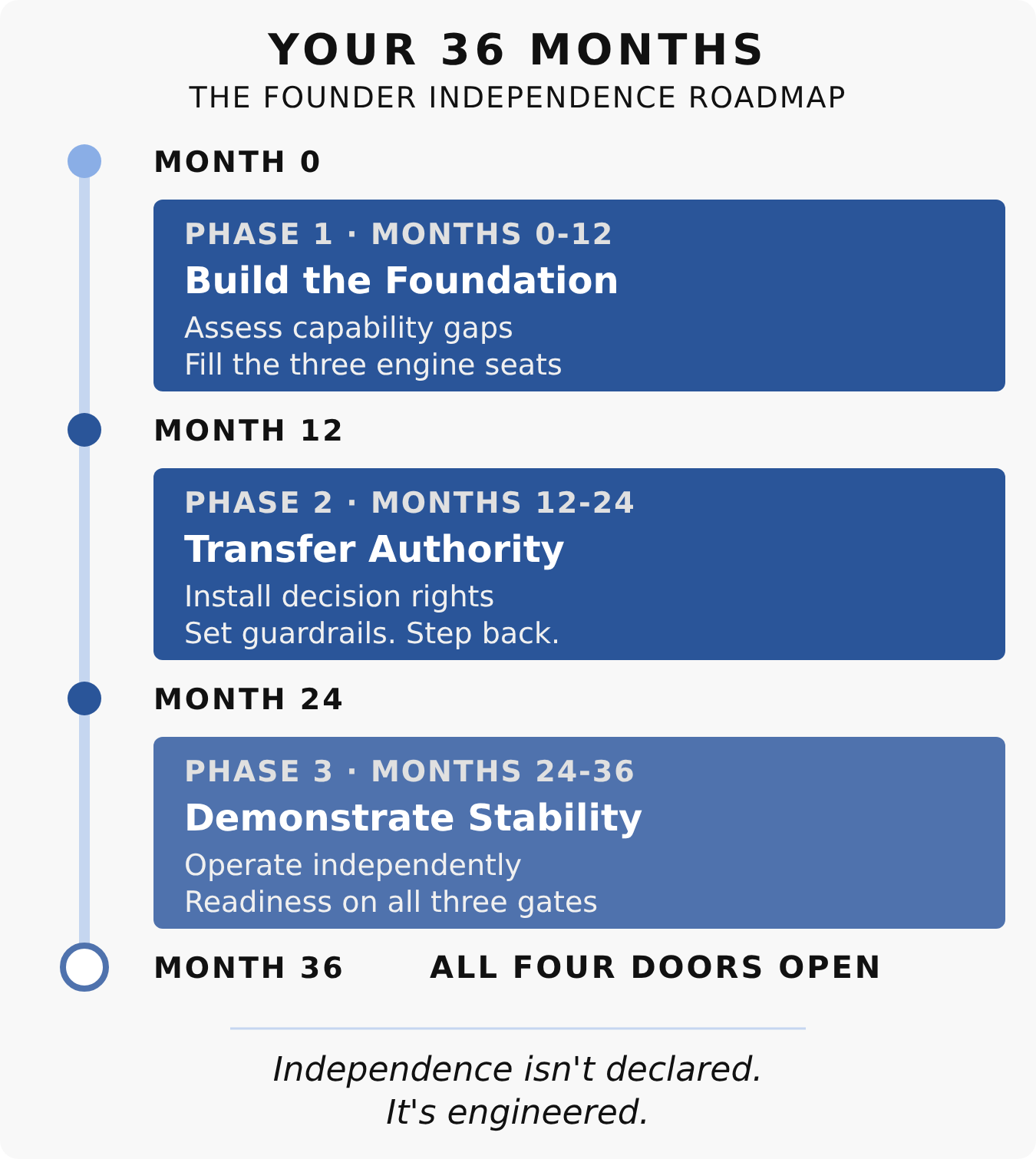
Short answer: If you want your company to run without you, look for a coach who moves decision-making authority from you to your leadership team in a planned order, with guardrails, and who can also facilitate the team's planning rhythm. I'm Herb Cogliano, a Certified Scaling Up Coach and Certified Exit Planning Advisor (CEPA). I do this work with founders of $3M to $50M companies in Boston, across New England and nationwide. The full path usually takes about 36 months. Selling is optional.
Why delegating hasn't worked so far
Most owners who tell me "I want it to run without me" have already tried delegating. The tasks went out and the decisions came back. People still stop by your office to ask. Projects wait until you weigh in. On a Friday afternoon your phone tells you the company still runs through you.
Usually there are one of two reasons. Either the work was handed off but the authority to decide stayed with you, or the authority went out with no structure around it, something broke, and you took it back. Both leave you more convinced that nobody else can do it.
What this kind of coaching changes
The work is moving authority, in order, so every leader knows what they own, what they decide and where the edges are. I teach it in three stages:
1. FACe. Every function in the business gets one named owner on the Function Accountability Chart. If two names share a function, nobody owns it, and if your name sits on six of them, that's the bottleneck.
2. Decision rights. For each function we write down which decisions the owner makes alone, which they make and tell you about, and which still come to you.
3. Guardrails. Then we set the limits a leader can act inside without checking with you, like spending thresholds, pricing floors and hiring authority. Guardrails are what make it safe to say yes. I call the result Safe Autonomy.
How the handoff works
Authority moves in three phases: Recommend, Decide, Run. First the leader recommends and you decide. Then the leader decides and tells you. Then the leader runs the function and you see the results in the weekly numbers.
It works like a trade apprenticeship. Nobody hands an apprentice a master electrician's license on day one, and nobody keeps a master electrician carrying the toolbox forever. Each leader moves up the ladder when the numbers show they're ready, one function at a time.
For the step-by-step version, including the One Quarter Rule and what to do when a handoff wobbles, see How Do I Hand Authority to My Leadership Team Without Losing Control?
Do you have to sell your business to step back?
No. Selling is one of four doors a founder can walk through:
- Sell to an outside buyer.
- Hand off to family, a partner or the leadership team.
- Recapitalize, taking some money off the table while keeping a stake.
- Architect and scale, keeping ownership while the leadership team runs the company and you work on the business.
The same work opens all four doors. A company that runs without its founder is worth more to an outside buyer, easier to hand to insiders and more fun to own. Inside buyers usually pay out of the company's future cash, so if the business still depends on you, your own exit is riding on how well it runs without you.
I believe in optionality. Without a plan, founders don't get to choose their door. Health, family or the market usually chooses for them. My job is to keep all four doors open until you decide.
I've done this from the founder's chair
Before I coached anyone, I ran the family business my father started in 1966. Sullivan & Cogliano made the Inc. 5000 three times and was named a Best Place to Work more than once. I built the leadership team that let the company run without me, and we exited in 2018. I'm also a 2x founder with an MBA, and I've worked full-time for nearly four decades. So I coach from experience: I've felt what it's like when everything runs through you, and what it's like when it stops.
One founder's story
A founder of a building-materials company came to me doing everything. He named his head of operations CEO and brought me in to help them move the authority across. Today the CEO and the leadership team run the business day to day. The founder spends his time on acquisitions, real estate and the bank relationships that fund growth, and he still sits in on quarterly and annual planning, the town halls and the celebrations. He never left the company. He just stopped being its bottleneck.
Where Scaling Up fits
As a Certified Scaling Up Coach, I facilitate your leadership team's annual and quarterly planning sessions. The planning rhythm gives the team a shared plan, priorities and weekly numbers to run on. Founder Independence moves the authority to the people running that plan. Combined, you get a team that knows what to do and has the authority to do it.
Is this a fit?
This work fits founder-led companies with $3M to $50M in revenue, where the founder has the beginnings of a leadership team and wants to work on the business, win time back for family and health, or both. Many of my clients are building toward $100M.
There are two ways to work together:
- Leadership Team Program: facilitated annual and quarterly planning with your leadership team, plus the authority transfer.
- CEO Program: one-on-one coaching for founders who are earlier in building the team.
See How I Work for details and Success Stories for what clients have done.
How we start
It starts with two conversations. In the first we look at where the business depends on you today. In the second we decide whether working together makes sense, and on what timeline.
Want a number first? Take the 5-minute Founder Independence Diagnostic. It scores how much your Revenue, Operations and Finance engines still run through you.
My book, Founder Independence, comes out in early 2027. Reserve your early access spot.
Frequently asked questions
What does an executive coach do for an owner who wants the business to run without them?
They help you move decision-making authority to your leadership team in a planned order. That means naming an owner for every function, writing down who decides what, and setting guardrails so leaders can act without checking with you. Then authority moves function by function, through the Recommend, Decide and Run phases.
Do I have to sell my business to step back from running it?
No. Selling is one of four options, along with handing off to family or insiders, recapitalizing, and architecting and scaling, where you keep ownership while a leadership team runs the company. Building a business that runs without you keeps all four open, so you choose the timing.
How long does it take for a company to run without its founder?
The path I use runs about 36 months for a $3M to $50M company. The timeline depends on how strong the leadership team is at the start and how many functions still run through the founder.
How is this different from regular executive coaching?
Regular executive coaching usually focuses on improving the leader. This work focuses on where decisions live in the company. It changes the structure around the founder, so the business still runs when the founder steps back.
Who is this not a fit for?
It's not the right fit if you plan to sell within the next few months, or if the company has no one yet who could own a function. In that case, the first step is hiring, and the CEO Program can help you get there. For more on choosing a coach, see How to choose an executive coach for a founder-led company and Best coaches for a founder-led company with a new leadership team.
When you're ready to choose what comes next, let's talk. Request a conversation